
The “Entrepreneur” Paradox: 5 Surprising Lessons on Tech, Risk, and the New World Order from Emmanuel Macron
During a recent high-profile visit to Mumbai, President Emmanuel Macron performed a rare act of protocol-breaking: he took to the city’s infamously hectic, “non-organized” streets for a morning jog. To the casual observer, it was a relatable moment of fitness; to the geopolitical strategist, it was a profound metaphor for the very nature of innovation. Macron’s willingness to embrace the unexpected reflects his core belief that progress cannot be perfectly engineered—it requires an appetite for the chaotic.
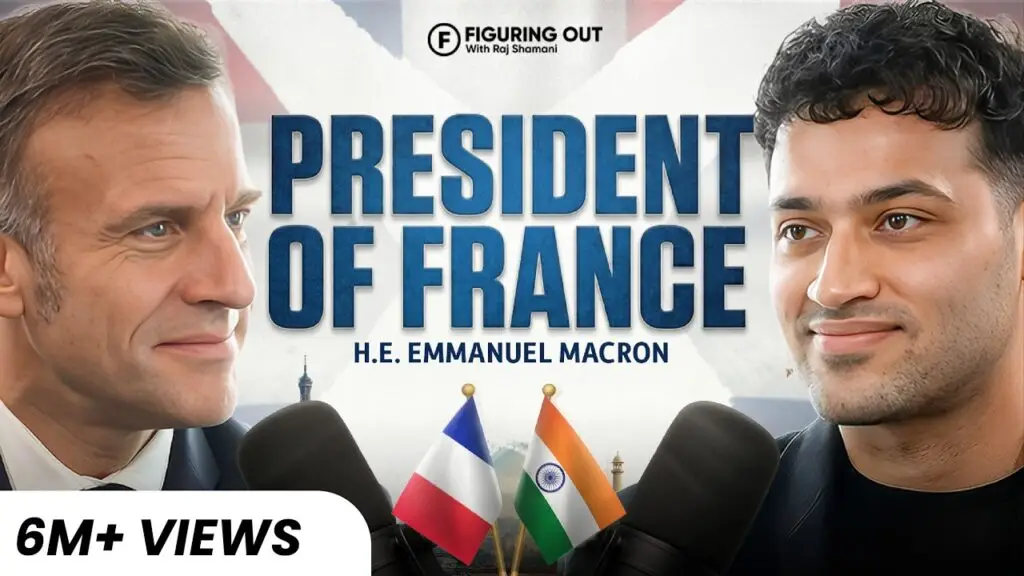
The paradox, however, remains: why is France, the nation that literally gave the world the word “entrepreneur” and “invented everything” from early cinema to nuclear milestones, now racing to avoid technological vassalage to the U.S. and China? In a candid briefing, Macron exposed the structural barriers to European resurgence and outlined a “Third Way” for a multipolar world.
1. The Structural Paradox: Why Europe Exports its Mindset and Capital
Macron exposes a structural paradox that threatens the very definition of European sovereignty. While France invented the concept of the entrepreneur, it has effectively exported the mindset of failure-tolerance to the U.S. and India. He identifies three pillars currently obstructing European hegemony:
- The Scale Deficit: Europe remains a fragmented collection of markets. To compete with the U.S. or China, Macron argues the domestic market must be viewed strictly as a unified bloc of 450 million inhabitants.
- The Capital Paradox: Europe possesses deeper savings pools than the U.S., yet suffers from massive capital flight. Due to a financing system unadapted to high-tech and burdened by regulation, these savings are channeled toward the bond market or flee the continent entirely in search of profitability.
- The “R” Word: A cultural deficit in risk appetite. Macron notes that innovation is not about being successful the first time, but about structural resilience.
“The question for innovators… is not to have people being super successful the first time; it doesn’t exist. But it’s to make sure that we have people ready to lose eight times but try nine times.”
2. The 2035 Moonshot: Picking the Quantum Winner
In the global race for technological supremacy, a head of state cannot afford to bet on every vertical simultaneously against the infinite bankrolls of Washington and Beijing. Macron has made a high-stakes geopolitical choice: Quantum Computing.
France is betting its future on this “moonshot” because of its unique density of world-class mathematicians and performing labs (such as Polytechnique and Normal Supérieure). The logic is simple yet brutal: the nation that develops a practical quantum computer first gains a “tremendous advantage” that renders current encryption and computing obsolete. By focusing on Quantum, Macron is attempting to leapfrog established dependencies and secure a lead in the next great disruptor.
3. Sovereignty as a “Host” Rather Than a “Client”
Critics often point to Macron’s €109 billion AI infrastructure project—which involves UAE funding and U.S. technology—as an admission of weakness. Macron counters this with a sophisticated “Build vs. Buy” logic. Through his “Choose France” initiative, he seeks to transform France from a tech “client” into a tech “host.”
- Regulatory Power: Buying a software solution from abroad makes a nation a dependent consumer. Attracting foreign direct investment (FDI) to build data centers on French soil ensures those facilities are subject to European data protection and regulations.
- The Mistral Alternative: While working with U.S. “hyperscalers” provides necessary immediate capacity, it serves as a bridge to scale domestic champions like Mistral AI, which Macron views as the premier European alternative to American Large Language Models (LLMs).
4. The “Third Way”: Rejecting the Uniformity of Giants
The France-India “all-weather friendship” is the cornerstone of Macron’s vision for a multipolar order. He defines “Strategic Autonomy” not as isolation, but as the refusal of “uniformity.” This is the “Third Way”—the refusal to be a dependent vassal of either the U.S. or China.
Macron finds a metaphor for this in India’s own cultural diplomacy. He noted with respect that Prime Minister Modi chooses to speak in Hindi on the world stage, reflecting a refusal to succumb to global linguistic uniformity. Strategic autonomy means ensuring that fellow citizens decide their own future; if a nation is technologically or defensively dependent on a foreign power, its democratic vote becomes an illusion.
5. Leadership and the “Civilization Process”
In an era where diplomatic norms are frequently shredded, Macron’s stance on civility is pointedly “Anti-Trump.” Reacting to the leaking of private diplomatic messages and threats of 200% tariffs, Macron argued that such behavior represents a “regression” from the “civilization process” that took centuries to build.
He contrasts the “rule of law” with the “order of the strongest.” For Macron, leadership is inseparable from respect, even amidst deep disagreement. He views the rise of hatred and violence in democratic discourse as a direct threat to the rule of law itself.
“Respect is part of the leadership… You can share ideas or not, you can disagree, but you have to do it in a respectful way within democracies as well.”
The Talent Bridge: Why “French Taste” is the New Competitive Edge
For the next generation of Indian innovators, Macron delivered a pragmatic correction to a common myth: the French language is not a barrier to entry. France is targeting 30,000 Indian students, with elite programs at institutions like Polytechnique and Paris-Urbain taught entirely in English.
The strategic “why” behind this push is clear: India now trains more engineers annually than the U.S. and Europe combined. Macron intends to plug this talent into a unique “Nexus”—the intersection of deep tech with gastronomy, fashion, and cinema. He argues that in an age of AI-driven commoditization, “French Taste”—the human-centric capacity to mix art, innovation, and life—is a premium competitive advantage that cannot be automated.
Conclusion: A Future Defined by Action
Macron’s outlook is a study in geopolitical tension. He is fueled by the optimism of a global “education boom,” yet wary of “uncharted territories” where the UN charter is ignored and 19th-century-style colonial wars return to Europe.
As France and India attempt to carve out a path between the two existing superpowers, one question looms over the “Third Way”: Is true strategic autonomy actually sustainable, or is the world inevitably sliding back toward the “order of the strongest”?